Modern Python Weekly #3
Python spent the week on stabilization and governance while AI labs shipped new coding, science, and evaluation infrastructure.

Python News
- Packaging Council Inaugural Election Dates - Python Insider published the June 28, 2026 announcement that the inaugural Python Packaging Council election will run in parallel with the 2026 PSF Board election.
💡 Modern Python's Take: packaging governance is becoming more formal because packaging decisions now shape almost every serious Python workflow. - Python 3.15.0b3 - Released June 23, 2026, this third beta keeps Python 3.15 on track for the final October 1, 2026 release and is the right target for compatibility testing.
💡 Modern Python's Take: if your library is not green on 3.15 beta builds yet, the cheap testing window is closing. - FastAPI 0.138.1 - Released June 25, 2026, this maintenance update follows the recent 0.138.0 frontend-serving work and continues cleanup across the framework's new surface area.
💡 Modern Python's Take: FastAPI is expanding beyond request handling into a more opinionated app-delivery layer, which changes the upgrade conversation. Read our in-depth guide here:
Serving a Frontend with FastAPI: A Practical Guide
A practical guide to FastAPI’s new app.frontend(), SPA fallback, API route priority, and a complete mini dashboard example.
 Yang Zhou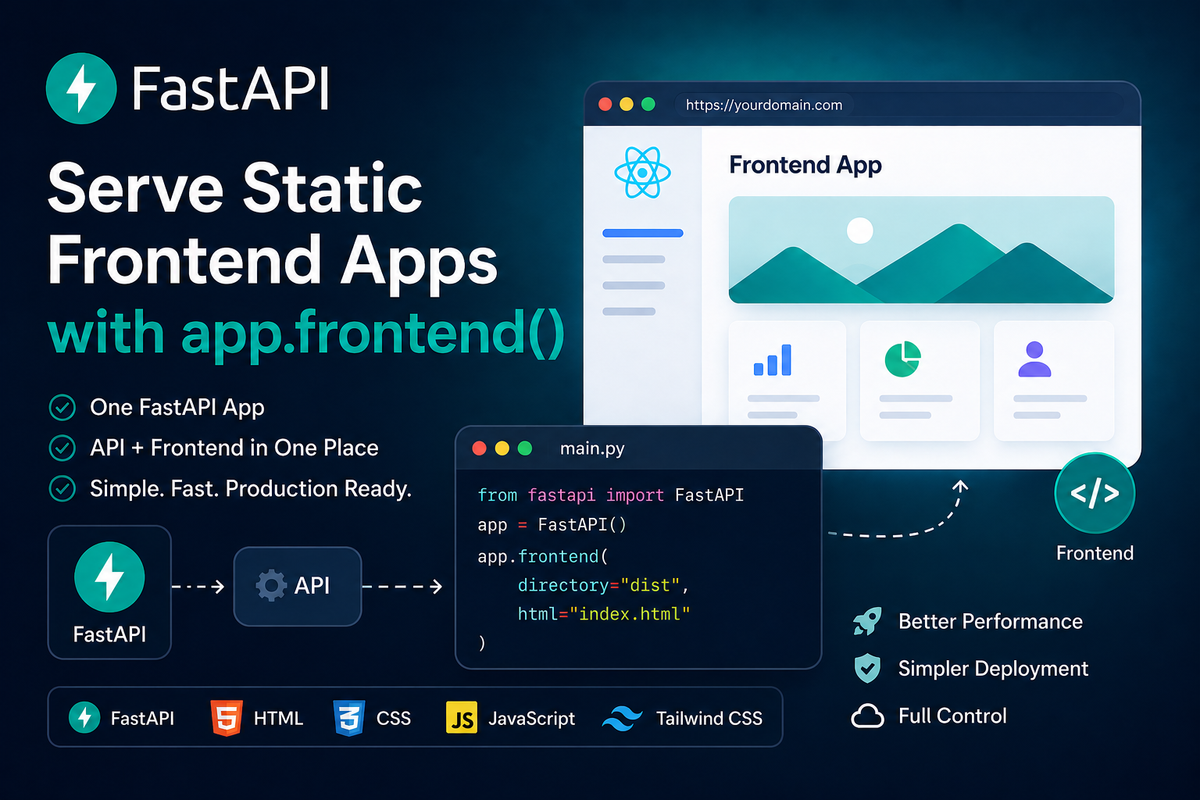
- Python Polars 1.42.0 - Released June 24, 2026, the latest Polars release adds cloud I/O concurrency work, optimizer improvements, and more sortedness-aware APIs for Python data pipelines.
💡 Modern Python's Take: Polars keeps pushing the DataFrame story toward larger-than-memory and cloud-shaped workloads without giving up ergonomics. - Announcing DuckDB 1.5.4 (Variegata) - DuckDB's June 17, 2026 patch release continues the fast iteration cadence around the 1.5 line for embedded analytics workflows.
💡 Modern Python's Take: DuckDB remains one of the clearest examples of where modern Python data stacks are heading: local-first, vectorized, and SQL-friendly.
AI news
- Previewing GPT-5.6 Sol: a next-generation model - OpenAI's June 26, 2026 preview positions Sol as its strongest model yet, with new
maxreasoning effort andultramode for subagent-assisted workflows.
💡 Modern Python's Take: the important shift is not just another model bump, but stronger support for longer-running, tool-heavy agent work. - Introducing Claude Sonnet 5 - Anthropic launched Sonnet 5 on June 30, 2026 with improved coding and agent performance plus default-on cyber safeguards.
💡 Modern Python's Take: frontier labs are now shipping capability gains and risk controls as a paired product story, not separate announcements. - Claude Science, an AI workbench for scientists, is now available - Also published June 30, 2026, Claude Science brings a scientist-oriented environment to macOS, Linux, SSH, and HPC workflows, plus grant credits for early projects.
💡 Modern Python's Take: AI-for-science products are getting serious once they meet researchers where Python, notebooks, and remote compute already live. - Introducing DiffusionGemma - Google DeepMind's June 2026 release presents DiffusionGemma as a text-generation model family designed for much faster decoding than standard autoregressive approaches.
💡 Modern Python's Take: alternate decoding architectures are becoming worth watching again because inference economics now matter as much as benchmark peaks.
Tools and Projects
- One of China's biggest ecommerce company to employees: Starting July 10, you cannot use America's ... - Published July 3, 2026, the report says Alibaba will ban employees from using Anthropic's Claude Code in office environments starting July 10 after internal reviews reportedly classified it as high-risk software.
💡 Modern Python's Take: AI coding tools are now important enough to trigger enterprise software-policy bans, especially where security, data residency, and geopolitical risk overlap. - Featuring Every Eval Ever Results on Hugging Face Model Pages - Hugging Face's new June 2026 integration makes benchmark results easier to publish, verify, and compare directly on model pages.
💡 Modern Python's Take: eval plumbing is becoming product infrastructure, which is exactly what the open model ecosystem needs. - ScarfBench: Benchmarking AI Agents for Enterprise Java Framework Migration - IBM Research introduced ScarfBench in late June 2026 to test whether coding agents can migrate real enterprise applications across Java frameworks while still building and running correctly.
💡 Modern Python's Take: this kind of benchmark matters because agent hype keeps outrunning realistic software-maintenance evals. - Vulnerability and malware checks in uv - Astral's June 8, 2026 engineering update adds
uv auditvulnerability checks and experimental malware detection to the Python packaging toolchain.
💡 Modern Python's Take: Python packaging tools are finally absorbing supply-chain defense as a first-class feature instead of delegating it outward. - GitHub Desktop 3.6 - GitHub's June 26, 2026 release adds worktree support, Copilot-assisted commit authoring, and AI-aware merge-conflict workflows.
💡 Modern Python's Take: worktrees and agent tooling belong together because parallel branches are becoming a normal coding pattern.
Articles
- Core dump epidemiology: fixing an 18-year-old bug - OpenAI's June 30, 2026 engineering post explains how a crash investigation split into a bad Azure host and an old GNU libunwind race condition.
💡 Modern Python's Take: this is the kind of systems writeup worth reading closely because modern AI products still depend on classic low-level debugging discipline. - Securing the future of AI agents - Google DeepMind's June 18, 2026 essay argues that increasingly capable agents require infrastructure-level controls, monitoring, and containment strategies.
💡 Modern Python's Take: prompt safety alone is not a real security model for agents with tools and autonomy. - Why Specialization Is Inevitable - This late-June 2026 Hugging Face essay argues that constrained systems repeatedly converge on specialization rather than broad generality.
💡 Modern Python's Take: the argument lines up with what developers already see in practice: smaller focused systems often beat one oversized do-everything stack. - Fluent, not native: agents translating pandas to Polars - Polars' June 25, 2026 technical post says AI translation from pandas to Polars usually runs correctly, while also identifying the structural patterns that still break.
💡 Modern Python's Take: this is a more realistic agent story than marketing demos because it treats translation quality as something measurable and improvable.